
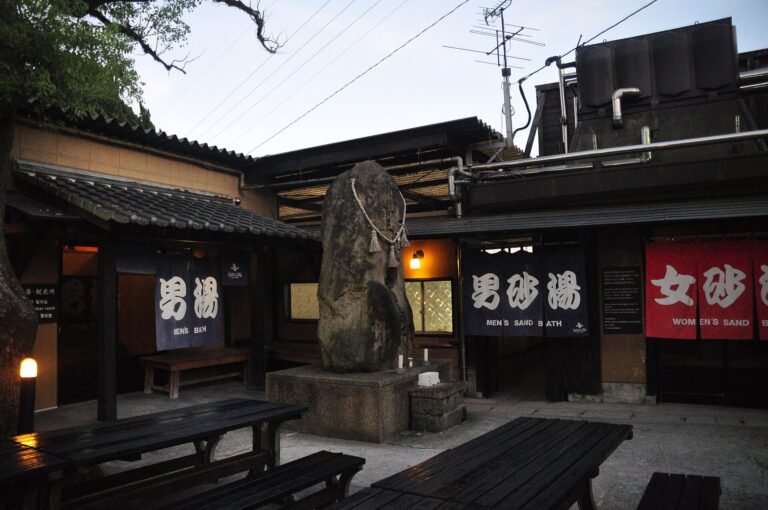
Whether you can use an onsen with tattoos depends entirely on the bathhouse. Some refuse tattooed guests, some accept them with conditions such as covering up, and some have no restriction. Check the venue’s own website before you go. If you can’t find a clear yes, book a private bath (kashikiri), where the question doesn’t come up.
Are tattoos allowed in Japanese onsen?
Sometimes. The Japan National Tourism Organization (JNTO) says many hot springs prohibit tattoos, while neighbourhood public baths (sento) are more likely to allow them. In practice every bathhouse sets its own rule, and rules can change. A friend’s experience last year or a forum post won’t tell you today’s policy.
What types of tattoo policy will you see?
| Policy (as shown on Onsenly) | What it means |
|---|---|
| Allowed | The venue says tattooed guests may bathe with no conditions. |
| Allowed with conditions | Tattoos are accepted under published conditions, for example coming alone or covering tattoos outside the bath. The listing text gives the condition. |
| Cover with sticker | Small tattoos may be covered with a cover sheet or sticker. Usually only suits small tattoos. |
| Private bath only | Tattooed guests may use private baths but not the shared ones. |
| Not allowed | Tattooed guests are refused. |
| (blank) | The venue doesn’t publish a policy. Ask before you go. |
Onsenly only fills in the tattoo field when the venue’s own official page states a policy. We never guess from reviews or third-party lists.
What does a conditional policy look like?
Tenzan Tojikyo, a day-bath complex in Hakone-Yumoto, is a good example. Its official policy accepts tattooed guests who come alone and keep their tattoos covered outside the bath. Conditions vary from bath to bath, so read the whole policy, not just the headline.
How do you check a bathhouse’s tattoo policy?
- Open the venue’s official website, ideally the English page, and look for “tattoo”, “notice” or “rules” (the Japanese word for tattoo is 入れ墨 or タトゥー).
- Read any conditions: covering, group size, time of day or private baths only.
- If the site says nothing, email or call before you travel, and keep the reply.
- On arrival, read the signs at the entrance. Posted rules apply even if a website says otherwise.
What are your options if a bathhouse doesn’t allow tattoos?
- Book a private bath (kashikiri). JNTO suggests private charter baths and ryokan rooms with their own bath for guests worried about tattoos. They usually cost more.
- Look for a venue that publishes a tattoo-friendly policy. Onsenly’s tattoo-friendly tag only appears on listings with an official “Allowed” or “Allowed with conditions” policy.
- Use cover stickers only where the venue permits them. A sticker isn’t a pass to a bath that bans tattoos.
Frequently asked questions
Can foreigners with tattoos use onsen?
The same rules apply to everyone. Whether you can enter depends on the bathhouse’s policy, not on where you’re from.
Are sento more tattoo-friendly than onsen?
Often. JNTO notes that public bathhouses are more likely to allow tattoos than hot springs, but check each one.
Do tattoo cover stickers work at every onsen?
No. Stickers only help where the venue’s policy allows covered tattoos, and they usually only suit small tattoos.
Is a private onsen a good option with tattoos?
Yes. In a private charter bath (kashikiri) or a ryokan room with its own bath, you bathe only with your own group.
What does “Allowed with conditions” mean on Onsenly?
The venue accepts tattoos under published conditions, such as covering them outside the bath. The listing text gives the exact condition.
Why do some Onsenly listings have no tattoo policy?
Because the venue doesn’t publish one. We leave the field blank rather than guess, so ask the venue directly.
Can tattoo policies change?
Yes. Check the official website shortly before your visit and read the posted rules on arrival.
What happens if I ignore a no-tattoo rule?
Staff can refuse entry or ask you to leave. Follow the posted rule or choose another bath.
Bottom line
Tattoo rules are set bathhouse by bathhouse. Read the venue’s own policy and conditions, ask if it’s silent, and book a private bath when in doubt. Onsenly marks a listing tattoo-friendly only when the venue says so itself.
Sources: Japan National Tourism Organization, “Bathing manners and tips” (japan.travel); Tenzan Tojikyo official English page (tenzan.jp). Verified Nov 2026.
Featured photo: Jordi Sanchez Teruel, CC BY-SA 2.0, via Wikimedia Commons.
